Professional Help

Lack of advice and help from a professional trainer can leave one feeling isolated and alone.

With the invention and wide-spread use of the Internet, it’s become easier than ever before to get information on dog training. There are web boards dedicated to various styles of training as well as specific dog breeds. Many professional trainers have their own blogs where they share some of their methods. Websites galore host various training tips and tidbits. Even without the Internet, there are a plethora of books available at local retailers and libraries. With all this information available at our fingertips, why would we consider taking our dogs to a dog trainer?

There are many reasons why a dog trainer is your best option. If you’re dealing with fear, aggression, reactivity, or other serious behavior issue; a qualified dog trainer is your best friend! First off, they can see your dog’s behavior and, based on other background information you may have given, determine what the exact issue is and the best way to handle it. Even writing out a detailed description of your dog’s actions and/or filming them behaving ‘badly’ isn’t the same as having someone actually see what your dog is doing in person. After all, a dog who barks and lunges at a passing dog out of fear can look a lot like a dog who is barking and lunging at another dog out of frustration.

Secondly, a dog trainer has a lot of experience working with dogs (and possibly a degree to back it up). In fact, depending on who you’ve hired, they may even have tons of experience working with your dog’s specific issue. You’re paying for their expertise and the experience they’ve gained working with dogs that had similar problems. This is invaluable. A qualified trainer will also be able to point out some of the mistakes you’re making; catching them before they become bad habits for both you and your dog. If no one’s there critiquing your skills, it’s hard to know what you might be doing wrong!

Finally, if you’re dealing with a serious behavioral problem, the trainer (and classmates) are a great support group. They have gone through or are going through exactly what you are currently experiencing with your dog. It’s so helpful to hang around with other people who have been there. Others who can share the pain and frustration as well as the joys when you succeed.
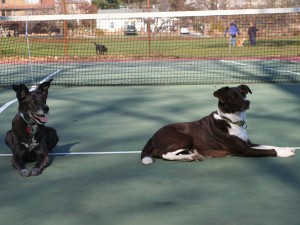
Having someone who understands what you're going through is invaluable.

That being said, there are certainly times when one finds themself unable to hire a trainer. Sometimes funds are tight or there just isn’t anyone qualified in your area. When that happens, all you may have available are books, the Internet, and maybe some dog-savvy friends.

While someone can certainly rehabilitate a dog on their own using information found online and in books, it’s a hard row to hoe. I know. I took that road. I was fortunate enough to have the support of a great clicker trainer when I brought Risa home and started her in classes. However, the classes were geared more towards general obedience and house manners. Not rehabilitating a fearful and dog reactive dog. Risa and I were still always welcome in classes and our trainer was very supportive of our efforts and the hard work I was putting into Risa. I think I would have had more success early on had we been able to get into a reactive dog-specific class. Even without having a local group of people who understood the trials of rehabilitating a reactive dog, I did find a group of individuals online who were going through the same thing I was and they became my support group.

So how does one go about finding a qualified dog trainer? After all, there is no governing body regulating dog trainers. Anyone can say they’re a dog trainer whether they have any experience or not. For information on dog trainers in your area, I would always recommend starting with The Association of Pet Dog Trainers (APDT). Once you’ve located a trainer, how do you know they’re a good one? There are several lists on various sites out there that discuss the finer points of selecting a good trainer. APDT has one here. The American Veterinary Society of Animal Behavior has a great .pdf outlining what to look for here.

Even though there is a lot of great information floating around the Internet, there is also a lot of bad out there. It’s hard to sift through it all and recognize what will work for you and your dog. Your best bet is always to find a qualified dog trainer to help you along. Advice on the Internet may be free but remember, you get what you pay for. 😉
Posted in Fear, Reactivity, Training | Leave a comment

Potential for Disaster

Still reactive? Or reformed reactive dog?

Right now, I’m working with a young puppy who’s in training to become a service dog. After spending several hours with her in a crowded space on Saturday, I determined that she has no self-control when she’s around people and dogs. She’s essentially the antithesis of Risa; wants to go and play with every dog she sees. There goes my theory that I’d rather have that than a reactive dog. 😉

I know that she needs to realize that not every dog she meets is a potential playmate. She must learn to control herself. Unfortunately, I am a bit limited when it comes to places I can work on this with her. Petsmart is a possibility as it has aisles that can be used as a visual barrier. Standing outside the dog park could work as well though I don’t think she’s ready for such high-activity and multiple dogs yet. My best option, however, is to work her around a single dog in an otherwise not-very-distracting place. We have to start slow.

Again, I find myself without access to proper bait dogs. A solid dog who, no matter what happens, will just sit there and allow me to work with the dog who needs help. Unlike whenever I’ve worked with Risa, I do have access to one other dog in this case. My dog. My dog reactive dog. And I hatched a plan.

While this seems like a completely asinine idea, pairing an over-excited puppy with a dog reactive dog, I know my dog. Risa has made outstanding progress as of late. She is far less reactive than she’s ever been and, even when she does have a meltdown, her recovery is speedy. I set up the training session so that everyone could succeed and that no one would get hurt or scared.

I placed Risa’s wire crate in the yard and put her inside of it. I stuffed her Kong full of raw meat and froze it so that she would be rewarded with a high value goodie during this event. I set up two chairs and covered them with a blanket to serve as a visual barrier for working with the puppy. This area was set up about 20 feet away from Risa. Fifteen feet behind that was my car. Although the main purpose of this set up was to work on the pup’s self control, I was ready to pull the plug and end it if Risa were to show signs of reactivity or excessive stress. Risa’s thoughts were just as important to me.

Risa did get a bit upset at the start when she saw the puppy. But it was more frustration about not being able to meet the puppy as well as the fact that I was so far away from her and working with another dog. The pup, of course, started barking and carrying on in her own meltdown of frustration so we retreated behind the barrier. It wasn’t far enough away for her to regain her composure so we moved back behind my car. Risa eventually calmed down and started digging into her Kong. In fact, she enjoyed it with her back facing the puppy!

I was able to work the pup using Risa as a distraction with no problem. While Risa enjoyed her Kong, she was a perfect bait dog. Non-threatening and relatively boring to look at. A minor major distraction for the puppy. After Risa had finished her Kong, she stood and watched us work which was a bit more distracting for the puppy. I was able to get the pup to within 20 feet of Risa and have her calm and collected. She was able to focus on me and do a couple behaviors. Then, I called it quits.

I was so proud of Risa. Who would think a dog reactive dog would EVER be a good candidate for a set up like this!?

Posted in Reactivity, Training | Leave a comment

The Frustrating Gut

Losing weight was often the only obvious sign of illness.

Risa has a long history of gastrointestinal (GI) issues. They started 6 months after I adopted her. She experienced loose poops and significant weight loss. I had no idea what was going on. Fecals came back free of parasites. Metronidozole (a commonly used antibiotic for treating diarrhea) didn’t have any effect on her. The vet I was currently seeing blamed it on Risa’s diet despite Risa being in excellent health up until that point. We switched vets and ran several more tests. The Giardia antigen test came back negative. At the advice of many of my German shepherd owning friends, we ran the TLI/Cobalamin/B12 digestive panel through Texas A & M. This blood test determines whether a dog has EPI (endocrine pancreatic insufficiency) or SIBO (small intestinal bacterial overgrowth). Risa came back positive for SIBO. We started her on a course of antibiotics (Tylan powder) and hoped for the best. I was happy to finally have some answers and began to see improvement within a month’s time. After several months on Tylan, I was able to stop the antibiotic without Risa ending up with diarrhea again. (Some dogs have to take Tylan for the rest of their lives to manage their SIBO.) During the course of her antibiotics, I also discovered that she was sensitive to salmon. Indeed, this may have been the food trigger that lead her into digestive upset as the treats I was giving her at the time were salmon-based.

Things were great for a while until spring rolled around again. Risa again experienced loose stools and weight loss. We ran the GI blood panel again and she was positive for SIBO. I started her on Tylan powder but, to my dismay, it didn’t help. The vet suggested B12 supplementation. I began with a supplement I purchased at the store to see if that would work. Unfortunately, it didn’t and we had to resort to B12 injections. As simple as they were to give, both Risa and I hated it. They seemed to have little effect as well leaving me more and more frustrated. My dog was skinny and not digesting her food properly. I wanted answers. I wanted to help her. Our vet wasn’t sure what else to do aside from exploratory surgery. I didn’t feel comfortable with that option and so I just hoped it would clear up on its own. It eventually did.

Just some of the various things I've tried to get Risa's gut under control. Herbs, probiotics, digestive enzymes, and supplements. Some from veterinarians and others I picked up to try.

Risa’s gut continued to flare up every year at some point or another. I tried several probiotics, supplements, and digestive enzymes on my own trying to straighten it out. I even tried some things our vet recommended with limited results. If any of the things I tried worked at all, the effect was only temporary. The only exception was slippery elm. However, slippery elm only coats the GI tract and eliminates symptoms. It didn’t get to the root of Risa’s GI problem.

I also discovered several more foods that she was sensitive to. Duck caused instant horrible poo. Soon jack mackerel began to bother her. Eventually, I had to stop feeding chicken and turkey. Finally, sardines were eliminated. I was in a difficult situation. Most of Risa’s raw bone sources were poultry-based and she could no longer eat them. The only alternative was pork which sometimes bothers her as well. I had to switch to premade raw (along with her usual muscle meat and organs) to keep her diet balanced and give her an edible red meat bone source. The premades are more expensive and many of the ones contain vegetables which I didn’t feel were necessary. It was difficult to find ones she could eat as well since many of them contain salmon oil!

I started off with Bravo Original beef formula and the lamb formula. Something in the lamb formula really set her system off so I stopped that immediately. The Bravo suited her well for a while but then, it too, started to bother her. I’m not sure if it was the vegetables in the mixes or not. I eventually switched to Answers Straight beef (which contains ONLY beef meat, organs, and bone; no veggies) and had some success with it at the time. Still, her gut was not okay. She’d been having digestive problems since September and it was now March. I’d never been able to get the answers I wanted through traditional veterinary medicine so I finally sought an alternative route.

Chowing down on a combination of 50% raw food (Answers Straight beef formula) and 50% home cooked food (a stew consisting of poria, celery, pumpkin, dates, and beef).

Risa saw a traditional Chinese veterinary medicine doctor in March this year. I instantly liked the idea of this methodology as I could easily relate it to the behavioral modification I’ve done with Risa. It’s all about treating the cause of the problem; not just suppressing symptoms! Over the last several months, Risa has had two aquapuncture sessions (it’s like acupuncture but instead of leaving needles in the points for several minutes, the vet injects a B12 solution into the points) and one regular acupuncture one to tune her meridians and restore the proper flow of chi to her gut. The veterinarian also designed a home cooked diet for Risa to consume as half of her daily ration. The original formulation contained barley which, it turns out, is another food Risa is sensitive to! (Can you feel my frustration?) Fortunately, we were able to eliminate the barley and substitute it with another food. The diet she created is supposed to purge the excess ‘heat’ from Risa’s system and restore balance to her body. We also tried some herbs along with the diet to see if we couldn’t get Risa’s gut back to normal.

At first, Risa’s poops were still inconsistent. She hadn’t lost weight (in fact, she gained about 8 lbs over the winter due to all the food changes!) and still looked fine. Except her poops were still soft. After we changed the gut stew to a version without barley, I started to see some improvement. Since things hadn’t been improving, the vet wanted me to put Risa on slippery elm again to calm her gut down. I did just that for 2-3 weeks and recently stopped it. I hate to jinx myself here, but Risa’s poops have been consistent and SOLID for about a week now!

I’ll admit, I never envisioned feeding my dog vegetables at any point in her life. I know a properly balanced raw diet is enough to meet her dietary requirements. For the most part, she did fine on a prey-model raw diet. However, I’ve decided that if she needs to be half and half, I’m completely cool with it. It’s possible that, once her gut gets back on the right track, I may be able to go back to feeding her a completely raw diet. Time will tell. All I know is Risa still looks great. Her teeth are no worse on this combination of premade raw and home cooked food than they were on a proper prey-model raw diet. Her coat and muscle tone is still excellent. Even better, her poops are GOOD! And, as much as I hate to admit it (as I believe dogs don’t need veggies), she absolutely LOVES the home made stew. 🙂

I just hope we’ve finally found a solution for Risa’s GI upset. It’s been a source of great frustration for me over the years. I mean, Risa would look completely fine and healthy excepting the fact that she was having horrible poo. I’ve never had answers and have struggled to get things under control. I felt utterly helpless in regards to her gut issues (unlike her behavioral problems which I have been able to successfully manage and fix). Here’s to hoping we’ve finally found the solution.

Posted in GI Issues, Raw Feeding | 2 Comments

Limitations

A young Risa thinking 'The sky's the limit!'

It’s come to my attention that some people believe that those of us who utilize mainly (if not exclusively) R+/P- in training fearful dogs are simply allowing our dogs to live their lives in their ‘safe zone.’ That we are content in owning dogs who are afraid and are perfectly fine in allowing our dogs to remain fearful. They assume that we don’t place our dogs in stressful situations, that we don’t subject them to some training pressure, and just accept them for what they are.

I think there’s a huge difference between management and behavioral modification training. While management is an integral part of behavior modification training, it is not the ultimate goal. With management, you basically limit what your dog is exposed to. For example, if they are afraid of other dogs, you keep them completely away from dogs.

Many dogs, fearful or not, may be subject to lives relegated to their safety zone if paired with owners who are content to let them be who they are. Even mentally sound, non-fearful dogs can spend their existence in a safe zone when living with the wrong family. If the person is unable to handle the dog’s high-drive or other behavioral ‘problems,’ the dog could be placed in the back yard and never taken out to experience the world.

With behavior modification, you work hard to expand your dog’s perceived safety zone. You do so by bumping his thresholds; gradually decreasing the distance at which he is too stressed to learn. It can be a long process, but you teach the dog that he can handle the world. For example, if your dog lunges at a person when they pass by at a distance of 10 feet, you start by walking by people 11 feet (or further) away. Once the dog is comfortable with people at 11 feet, you move a foot closer. If he can handle that distance, you decrease it again (or if he can’t, you step back and work at the previous distance again for a while). You move at the dog’s pace and his perceived safe zone expands.

Taking it all in stride. No fear here!

It’s not about accepting who your dog is. Had I just shrugged my shoulders, said “Risa’s a fearful dog,” and given up, she wouldn’t be the dog she is today. I could have just kept her inside my apartment and never let her experience the outside world. After all, outside my door was a narrow hallway where she had to pass people that sent her fleeing to the end of her leash. Further along was an open courtyard with scary poop disposal cans, more people, kids, and other dogs. Beyond that was a busy roadway with cars rushing by and monstrous sandwich board signs waiting to frighten the poor wuss dog Risa.

Keeping her inside for the rest of her life was not an option. We didn’t have anything close to a private yard for most of our time together so walks were our only option for exercise. Since Risa was an active dog, she would have driven me nuts staying inside all the time. On top of that, I had big plans for her. Though I may have been a bit naive at the time, I wanted her to be my competition dog. For her to be able to handle that sort of pressure, I had to show her the world was not so scary. I refused to accept the limitations of having a fearful dog. I wanted her to fully realize her potential.

Now, that’s not to say I don’t accept that Risa is a fearful dog and some of the limitations associated with that fact. I know that she’s probably never going to be a gregarious dog with people or other dogs. She may always be reserved and afraid in new locations. And that’s okay. However, had I decided to just let her be afraid, she wouldn’t have accomplished everything she has. Risa wouldn’t have been able to reach her innate potential.

Because I required her to step outside of her comfort zone on occasion, she has learned how to handle stressful situations. It’s amazing to watch her in a situation that used to cause her to panic. I can see the gears turning in her head as she considers her options and makes the right choice. She no longer shuts down in the face of pressure; she can work with me even when she’s overwhelmed. The best example of this was our last rally trial. It was loud, crowded, and Risa was pretty stressed out. Despite her obvious stress, she didn’t shut down in the ring. She didn’t run out of the ring and bolt for the door. Risa stayed alongside me in a loose heel and performed the signs. Granted, her performance was sloppy and her focus was terrible. But she did not break under pressure. (I have since decided she will not be competing in AKC rally at this time as the trials are too overwhelming for her.) The dog I brought home from the shelter would have flopped over on her side, exposed her belly, and refused to do anything. Risa’s come a long way!

I don’t think it’s fair to lump all fearful dog owners together and assume we all just accept our dogs as who they currently are and just go on with our lives. Some of us are out there actively changing our dog’s worlds and helping them live up to their potential. And we and our dogs are all the better for it.

Posted in Fear, Reactivity, Training | 4 Comments

Coursing Enthusiast

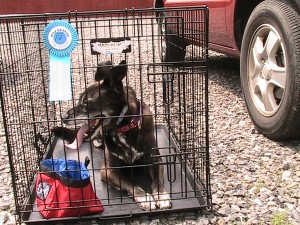
Relaxing (for the moment) in her crate and showing off her new ribbon!

I knew as soon as I took Risa herding (a.k.a. ‘chase sheep when they move’) that she was a natural born coursing dog. She’s always enjoyed running free and I honestly think nothing makes her happier than sprinting at full speed. I’m so fortunate that I’ve been able to take her to lure coursing and allow her to do what she’s designed for.

Sure, she’s a mixed breed mutt but it’s highly likely she’s got sighthound in her background. Her body shape, her foot construction, the double suspension gallop, and her fixation on chasing fast-moving objects point to that ancestry. If nothing else, she’s a natural at lure coursing.

The weather finally cooperated and allowed us to get out for our first coursing day this season. Risa could not have been happier. And I could not have been happier with her. It seems she finally ‘gets it.’ When the plastic bag ‘bunnies’ stop moving, she grabs onto them and tugs like crazy. This is the ideal outcome; I don’t have to try and recall her if she doesn’t run away! All I had to do was walk up to her and take hold of her collar. Amazing. I guess all of our work with the flirt pole has helped! Because she was so good, I let her run a third time. 😉

Today she earned her WCE (Wylde Courser Enthusiast) title. To earn this, she had to successfully course three times. She earned one leg last year and two today (plus a leg towards the next Wylde title). It may only be a local title, but I’m just as proud of her for this one as any of the others. One thing I’ve always enjoyed is watching a dog do what they were born to do (even if, being a mutt, Risa wasn’t bred for any particular purpose).

On top of her outstanding performances in the field, she was equally impressive off the field. I was unable to keep her in my car (the noise of the lure moving sends her over the edge and I feared for my vehicle’s safety) so I crated her. Since we weren’t staying for more than a few hours, I didn’t want to set up everything so I didn’t put up the visual blockers. Risa watched one dog pass by her crate without a single change in her behavior. I praised her from where I was standing and then went to the car to get her a treat.

A short time later, another dog came right up to her kennel to sniff her! I was waiting for the explosion but it never happened. Instead, Risa sniffed the dog through the bars of her crate! At that point, aside from praising/treating her, I asked her “What have you done with my dog!?” I couldn’t believe it. Though she later snarked at passing dog while kenneled, two outta three ain’t bad!

For fun, here is a video of Ris’ third run of the day. I apologize for the shoddy camerawork; I haven’t practiced with my video camera much!

Posted in Lure Coursing, Reactivity, Training | Leave a comment