This Is No Time For Corrections

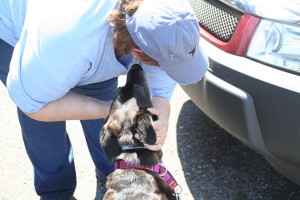
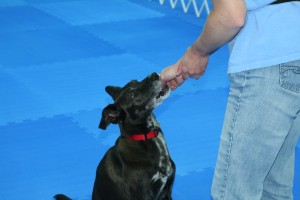
Working on dog reactivity using a food tube to reward good behavior.

While I find no need for positive punishment in my training bag, I’m willing to accept that many people do. That’s fine. However, I disagree about using corrections with a reactive dog. In fact, I think that is one instance when you should never ever use corrections. (Keeping in mind that, when I say “reactive,” I am specifically talking about dogs who bark/lunge/etc. out of FEAR not out of party-starting.)

You have to keep in mind that reactive behaviors are not thinking behaviors. Behaviors like “sit” and “down” originate in the front part of the brain. The mammalian brain. The thinking brain. Reactive behaviors like running away from a scary thing come from the hind brain. The lizard brain. The reactive brain. A dog who is reacting is NOT thinking. It’s pure instinct. They are in survival mode. This also means that, even though you say “sit” and they know what “sit” means, they are incapable of responding to your cues at this time. At the very least, a correction is not going to do anything. You cannot train when the dog is not in a thinking mode. At the very worst, you’re going to pair another negative event with an event that is already negative. You could accidentally associate corrections with the presence of the scary trigger making it even more negative for your dog. Just because your dog isn’t thinking doesn’t mean he isn’t learning.

It’s also vital that you separate a “bad” behavior and the reward for a good behavior with time and distance. Otherwise, you are essentially rewarding the bad behavior as well. I’ll use the example trainer Tracy Sklenar mentioned at the seminar I attended this weekend. If your dog runs off to eat horse poop and you call them back to you and reward them for returning, you’ve effectively rewarded them for “going off, eating horse poop, and coming back when you call.” You haven’t simply rewarded the recall but the entire sequence! So if you correct a bad behavior (no matter how you choose to do it) and then cue another behavior and reward that, you’re keeping the behavior chain alive. React, correct, sit, treat. The “react” will still be there because you haven’t broken the chain. If your dog reacts, you step backwards 10 steps, cue an alternative behavior, and reward compliance; you can break the chain.

Keeping a dog at a distance where they're comfortable and rewarding them for being successful is the best way to rehabilitate a reactive dog.

You need to work a reactive dog below threshold. At that fine line between a full blown reaction and “I am stressed but still okay.” You cannot train a new behavior if they are not in thinking mode (aka reacting). If they react, get outta there. Plain and simple. You messed up and got too close. Reset and try again. It’s a delicate balancing act but it does pay off.

There is NO EASY FIX. You can use corrections and eliminate the outward signs of the reactions but you will not create a more confident dog. Addressing the barking/lunging/spinning/snapping will not change the way your dog feels about the things that bother him. He might learn not to do those behaviors, but he still feels incredibly uncomfortable. And, if he doesn’t show outward signs of his discomfort, you could put him in a situation where he feels in over his head and, instead of barking, he reaches out and just nails someone instead “without warning” because you took all of his warning signals away.

Working with a reactive dog is HARD. It’s hard on the dog and it’s hard on the handler. I cannot tell you how many nights I cried and how frustrated I was working with Risa at the start. How much I sometimes hated being with her and that I didn’t think she liked me at all. We had no bond together. I was completely lost. . .and even later when I did know what I wanted to do, it was hard. I spent about 4 years carefully managing situations to set her up for success. It’s only in the last year or so that I’ve been able to relax more knowing Risa has the ability to cope in stressful situations. I still have to be on my toes but it’s so much easier now!
Posted in Dog Training Seminars, Fear, Reactivity, Thoughts, Tracy Sklenar, Training | Leave a comment

Cookie-Pushing

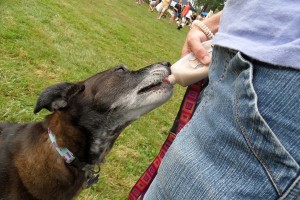
Dogs should be paid for doing a good job.

When I first got Risa, I wasn’t into the whole “clicker deal.” I believed in using positive punishment as a way to proof behaviors a dog already knew. I trained new behaviors with treats. Once Risa knew it, I introduced punishment to make sure she did it immediately. That she knew she HAD to listen to me. But then I discovered clicker training. I didn’t switch over immediately. I clung to my prong collar so that I could enjoy walks with Risa (note that I never trained her to walk nicely, the prong collar simply didn’t allow her to pull). I still believed she was wrong when she reacted. But I eventually realized clicker training was the way to go and I’ve never looked back.

I like clicker training for a lot of reasons. One, the focus is on what the dog does right. It is so easy to see what our dogs are doing wrong. We humans are really good at pointing out mistakes. But that’s not the kind of attitude that fosters a positive relationship between two individuals. If all you see are the mistakes someone makes, how do you feel about them? It’s not a positive feeling, is it? You might come to resent them. But, if you focus on the good things rather than the bad, your whole attitude changes. Even if your dog does 10 “bad” things and 1 good one, your focus is on the good one. The thing you can reward. The thing that, once you reward it enough, will overshadow the bad thing. You learn to look for the good in your dog (this can also apply to your relationships with people too!).

Another thing I like is that it’s not adversarial. It’s not about “You are disobeying me and not doing what I want!” It’s about a partnership. Active communication between dog and handler. Both sides’ opinions are of equal importance. Besides, I had a lot of trouble distancing my frustration with Risa’s non-compliance from collar corrections. You’re not supposed to correct out of frustration or anger. . .and I had a lot of difficulty not doing just that. Clicker training eliminates that problem. (These days, if I get frustrated, I stop training and take a breather rather than getting increasingly annoyed with my dog.)

It's all about the relationship!

I also like that it builds creativity and confidence. Dogs aren’t ever “wrong” in clicker training. You simply wait for them to be right. They’re not afraid to try new things and they learn to deal with and work through frustration. Do you remember the first time you tried to shape a behavior with your dog? The only input they have is whether they get clicked or not. If they do get a click, they have to figure out what they did to earn it. That is frustrating. But a clicker-savvy dog will work through it. They will keep trying until they finally realize what gets them the reward. These dogs learn to deal with stress and realize that it’s not a big deal.

I also know that, had I not embraced clicker training 5 years ago, Risa and I would not be the team we are today. She really needed the confidence-building that clicker training provides. She needed to learn that she did have control over the world. Risa needed a handler who listened to her and understood her fears. One who was willing to go home if a situation was too much for her to handle rather than expecting her to just deal with it. A handler who was willing to take the time to teach her how to cope. A person who realized her potential and refused to give up knowing that she could reach it if we just tried hard enough. Clicker training taught me to be that person.

Posted in Thoughts, Training | Leave a comment

Liebster Award

What a pleasant surprise for me this morning! I found out that Belle, writer over at Just Between Us, has awarded me with the Liebster Award. Liebster is German for “Dearest” and this award spotlights some lesser-known blogs. I must say I am honored to receive it. Thank you so much!

I’m also supposed to highlight some other lesser-known blogs to give this award to. I honestly don’t follow as many blogs as I would like to and many that I do follow are more well-known. But here are a couple blogs that I would recommend (that I think have less than 200 followers). 🙂

Got Spots’s Blog

Holistic Canine

Pam’s Dog Academy

Scratch My Butt

Success Just Clicks (Though the URL for this blog will be changing shortly.)

Thank you again, Belle!

Posted in Uncategorized | 6 Comments

Tipping the Scales

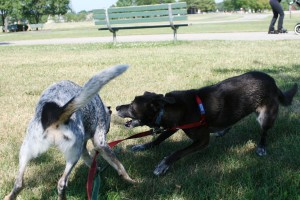
Another dog jumping on top of her can be a very stressful situation for Risa. She usually allows this behavior from close friends but not strange dogs.

Life is unpredictable. Even when you’re training, life interrupts you. It can spoil the perfect set up. It can destroy months of rehabilitation training. How can we help ourselves and our dogs learn to cope with life??

With Risa’s history and fearfulness, it is my goal for her to have as many positive experiences as possible. With people. With dogs. With novel objects and new locations. I want things to be 100% positive. Why would this be my goal? Am I setting us both up for failure knowing that such a thing is practically unattainable?

The short answer is “No.” I am not setting us up for failure with such high expectations. I’m setting us up for life.

It is impossible to always have a good experience somewhere. But, when you have more good experiences than bad ones, you can bounce back from the bad easier. Your history with that thing tells you that bad things are an anomaly in that situation. It prepares you to deal with life.

I am afraid of centipedes (we call them “million leggers” in my family). I know it’s an irrational fear as they are completely harmless. It’s their appearance that unnerves me. Growing up, we had a walkout basement so they were commonly found in the house. If, every time I went down into the basement, I had seen one of these critters, I would probably have stopped going down there. It would be even worse if they ran across my foot or ran out in front of me every time. Pretty soon, I would have refused to go downstairs at all! It’s no different with our fearful dogs.

"Most people aren't scary so I can be their friend!"

When I first got Risa, she was afraid of people. I wanted her to become more comfortable with them and I allowed strangers to try and pet her. Unfortunately, she did not wish to have contact with them and shied away. The more they insisted on touching her, the more fearful she was. Even if they had food to offer her, she was conflicted about approaching them to get it. People remained a scary thing. She started to worry that all people were going to try and touch her. It wasn’t until I stopped letting most people pet her and only allowed interactions with people who I could trust to approach her properly that she really turned a corner. She learned that the majority of people are not going to try and touch her. That she can simply walk on past them without any concern. Through experiences with a select few, she has become more comfortable around people and will accept tactile affection from strangers on occasion.

This goes for dogs as well. Risa was scared by a lot of dogs early on in our relationship. She started to view every dog as a potential scary event which set her up to become a dog-reactive dog. Now, it’s my goal for her to view dogs as a good thing. I’ve done classical conditioning to pair the sight of other dogs with food. Seeing dog = awesome food reward. I’ve done “Look at That” to give her permission to check out the scary thing and then reward her for checking in with me. And I’ve recently started integrating BAT (Behavior Adjustment Training) to teach her that she can create distance from other dogs without resorting to reactive lunges and barking.

I’ve also allowed her to interact with carefully selected dogs so that she could learn how to behave properly. I have to be very cautious when I do this, however, as I want to pair her with a dog who isn’t going to frighten her. No “Tarzan Dogs” or socially inept ones. They need to be relatively calm with good social skills. I want Risa to have good experiences up close and personal with dogs so that, should she find herself in a situation that gets out of hand, she can cope. Despite my best efforts pairing her with other dogs, she has had bad experiences with them. Several times, she has gotten tangled in a leash and was essentially ‘pinned’ to the other dog. She panicked and reacted. After separating them, the two dogs were fine together later on in the day. She’s also had several canine arguments but is still close friends with those dogs despite it all. Why? Because she’s had mostly good experiences!

"I can open up, put down my guard, and just have a blast playing with you!"

In fact, yesterday I took her out for another day of off-leash fun. While we were having fun in the fenced area, someone came by with their dog. The person came inside the fence to meet Risa but we had his dog stay outside. Risa and the other dog looked at each other from opposite sides of the fence with slightly stiff body postures. Eventually, the outside-the-fence dog approached the bars to meet Risa. Ris kept her head low, did a tongue flick, and raised her left paw as they greeted face-to-face. After the greeting, Risa flopped into a playbow and they raced along the fenceline together. They stopped, Risa bowed again, and they chased each other back. I was astounded. I’ve seen Risa playbow to other dogs before but only dogs she has met several times. Never a dog she just met! But, because she’s had many more good experiences around dogs than bad (in recent history), she felt more comfortable opening up to a new friend.

By aiming for positive interactions, we set our dogs up for success over the long haul. Life isn’t perfect and bad things will happen. But, when the good outweighs the bad, we learn to let the bad go and move on.

Posted in BAT (Behavior Adjustment Training), Classical Conditioning, Fear, LAT (Look at That), Reactivity, Training | 1 Comment

Book Review: Behavior Adjustment Training

Got a reactive dog or one who needs to learn some social graces? Get your paws on this book!

I hate when life gets in the way sometimes! I was so excited to get this book; I even pre-ordered it! Last night, I finally finished reading it. I must say, I’m so glad I did.

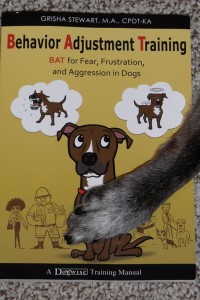
Behavior Adjustment Training by Grisha Stewart is an excellent resource for people who own reactive dogs. But I think anyone with a fearful dog or party-starter dog (also known as a “Tarzan Dog,” a term coined by Jean Donaldson) can benefit from the exercises contained within. The same protocol can also be used to help fearful dogs gain confidence.

The book gives a nice overview of the basic principles necessary to start Behavior Adjustment Training (BAT) as well as how the author developed the protocol. Along with detailing how to set up a session, she also goes into great detail about using BAT in everyday life and even spends time focusing on management strategies for the interim while you’re working with your dog (or when you can’t). The illustrations and diagrams within are also extremely helpful, especially for visual learners. The drawings also simplify the concepts in a way that allows the reader to easily comprehend the more complex aspects of BAT.

I also enjoyed the sections at the end which delved into clicker training, quadrants, and other nerdy aspects for those of us who are interested in that sort of thing. 😉 The first-hand accounts and reviews from dog training professionals were a nice touch as well.

I’m always looking for more tools to put in my toolbox when it comes to dealing with Risa’s reactivity and BAT is an excellent compliment to the other tools in the box. In fact, I really like the concept because it empowers the dog to make the right decision. This is huge for me as I do not wish to be constantly on alert and always prepared for disaster when I’m out with Risa. Now that Risa is more confident around dogs, I have focused more on giving her the skills she needs to cope. I reward the good decisions she makes. With BAT in the mix, I can reward her with what she really wants: distance.

We don’t have a lot of willing decoy dogs at our disposal so I’ve been using BAT with dogs we encounter on our walks. It’s a bit more unpredictable this way but we’re still having success. I simply walk off the path and wait. When Risa offers eye contact with me (I’m being a bit more specific with her and only rewarding eye contact rather than any calming signal), I mark and we walk away from the dog. Already, I am noticing that on non-BAT trials around dogs, she is choosing to move away from the dog when she feels uncomfortable rather than posturing and lunging.

Along with using BAT on Risa, I implemented it today with “Tarzan Dog” Callie. Callie wants nothing more than to play with other dogs and she’s not always socially appropriate. I wasn’t having much luck doing what I usually do with her. Even walking away from the other dog and waiting for her to be calm before trying to approach again was simply not working. So I decided to try some BAT with her. Unlike with Risa, however, I rewarded Callie with decreased distance rather than increased. I stood there with Callie and waited for calm eye contact with me. (I think if I had waited for a calming signal, I would have been there all day!) When she made eye contact, I clicked and took a step forward. Then I gave her a treat and waited again. We were able to get within 5 feet of the other dog before it was a bit too much for her and I had to walk her away when she lunged. I tried it 2-3 times and saw significant improvement. It was like a lightbulb had turned on and she understood that only calmness would get her closer to the other dog.

Overall, I think this book and the training methodology contained within should be a part of everyone’s toolbox. It can be adapted and utilized in many ways which makes it extremely versatile. It also compliments other training methods like LAT (Look At That), classical conditioning, and desensitization. BAT gets a big 2 paws up from this reader!

Posted in BAT (Behavior Adjustment Training), Books, Fear, Reactivity, Training | 1 Comment