Truth and Consequences

There are consequences for every action regardless of how you train or what you choose to do.  Even doing nothing at all is a consequence.  Whether it's good or bad depends on your point of view.

There are consequences for every action regardless of how you train or what you choose to do. Even doing nothing at all is a consequence. Whether it’s good or bad depends on your point of view.

I recently read an article that brought up some deep discussion with fellow dog training nerds. The article itself focused on why positive reinforcement-based training fails and why a balanced approach is better. I’m not going to argue that point as I tire of doing so. I simply do what I do and let the results speak for themselves. 🙂 However, there were several points brought up in the post that I feel need addressing.

First of all, the idea that positive-based training is consequence-free. That couldn’t be further from the truth. Everything you or your dog does has a consequence. It can be a good one or a bad one (and often whether it’s good or bad depends on whether you’re the dog or the trainer!). Ignoring behavior IS a consequence. Giving a treat reward is a consequence. Issuing a correction is a consequence. Training dogs is all about consequences and manipulating them.

If I’m working on waiting at doors, I have several options. If the dog waits calmly at the door when it’s opened, the consequence is that he gets to go outside. If he blasts through the door as soon as it opens, the door is closed and he does not get to go outside (keeping in mind that I’m training so the dog is on a leash to prevent him from self-rewarding with a romp around the yard). You could also give a leash pop or a “No” as a consequence for attempting to go outside before being released to do so.

It’s the same with jumping up. I can ignore the behavior in which case the consequence is that nothing happens for the dog. No going outside or attention from me at all. I can cue an alternative behavior like “sit” and reward that when he complies. Or I can wait for a sit and reward that when he offers it. I can also yell “No” though that can potentially reinforce the behavior if it’s an attention-seeking one. I can also knee the dog in the chest or step into his space though that might inadvertently convince a dog that he shouldn’t come into my space at all (especially if you have a sensitive dog). All of these are consequences for the jumping up behavior from various schools of thought.

The other thing I want to address is the idea that positive training falls apart in the real world because you can’t control the real world in the same way you can in a classroom. Certainly, the idea behind positive reinforcement-based training is that you set things up so that the dog has no choice but to do things right. It’s difficult and often involves a lot of creativity to set a dog up to perform what you want and be unable to do what you don’t want to reward. The whole idea is to teach the dog the proper response in the quickest way possible. Once the dog knows the behavior, you can fade your training tools and start to add in distractions and other real-life scenarios. You slowly work your dog up so that they continue to have success as things get harder. Will real life happen in the meantime? You bet it will. You can’t train for every situation no matter what methods you use. There will be times when you find yourself and your dog in a situation that you haven’t trained for and will need to act anyway. It happens. You just keep on truckin’ and keep that experience in mind as you continue to work together.

No training happens in a vacuum. Even if you train in your living room, it’s not the same every day. There are different scents and different sounds. The lighting can be different. The issue is that training in the same location does not translate to the real world. If the only place you ever train is at the training center, your dog will only be able to perform there. It doesn’t matter what method or ideology you follow. Dogs are poor generalizers. If you only train in a classroom and never anywhere else, the dog will act like it has never been trained whenever you take them elsewhere. That is the issue. Not the methodology. The idea that training only takes place at home or at class. Or that a 6-week class is enough for your dog to be considered “trained.” Training is a life-long process and the training must be maintained. It’s like that old saying “if you don’t use it, you lose it.” Heck, I have even seen dogs with obedience titles who can heel off leash with their handlers inside the gates pulling like freight trains on Flexi leads once they’re outside of the ring. The dog knows how to heel in the ring but the behavior is not reinforced outside of it. Same issue.

All behavior has consequences. That’s how the world works. And, if you want compliance everywhere, you’d better start training everywhere. 🙂

Posted in Thoughts, Training | Leave a comment

Comfort Zone

Fearful dogs are often very comfortable in their home environment and act completely different when taken elsewhere.

Fearful dogs are often very comfortable in their home environment and act completely different when taken elsewhere.

I find the best way to truly learn who a dog is is to take them out of their comfort zone. Fearful dogs often act completely different in their home environment compared to the wide world. Risa was like that. When she was with me in the apartment, she was fine. As soon as we walked past the threshold of my door, she was terrified. People, objects, dogs. . .everything scared her. It was like night and day. Comfortable indoors. A nervous wreck outdoors. If you had judged her by her inside behavior, you never would have really understood what her problems were. And you would have been in for a big surprise.

Sawyer is much the same way. When I brought him home, he was nervous and unsure. That didn’t last long, however. He came out of his shell rather quickly and he feels pretty comfortable here. Even when I bring over visitors, he is relatively okay. It does still take him time to investigate them and determine they are okay. People still frighten him a little. But he’s really beginning to overcome that and actively solicit attention from them. I’m finding he’s enjoying being petted by me more as well.

He’s also absolutely in love with Risa. He really enjoys playing with her and having her around. I was told he was good with other dogs and I had no reason to doubt this. After all, he and Risa hit it off almost immediately. It wasn’t until I took him to an adoption event to help him find a new home that I realized this is not the case. Sawyer, much like Risa, is afraid of other dogs. He’s fine being around them; just seeing them isn’t enough for him to act fearfully. If they get up in his space, however, he is not okay and he reacts.

If I’d never brought him outside of my home, I would never have discovered this side of him. While I delayed taking him out right away to give him time to settle and learn to trust me, I am glad I did take him out of his comfort zone. I am glad I discovered who he truly is so that, when the right person comes along, they can have his whole story. I would hate for someone to think they just adopted a dog-friendly dog only to find out that he turns into a snarling beast when another dog comes by to say “Hi.” (Especially since I have been that person. I was told Risa was okay with dogs too.)

It's amazing that two dog reactive dogs can co-exist in my home.  I know this is rarely the case without a lot of effort!

It’s amazing that two dog reactive dogs can co-exist in my home. I know this is rarely the case without a lot of effort!

This is why I think it’s critical that you evaluate a dog in a strange environment to really determine who they are. With a confident dog, it shouldn’t matter much. They approach almost anything without issue. When dealing with a dog with temperament faults, it really shows you who they are and what you’re going to have to deal with. It allows you to make a decision: can I handle this problem?

I certainly don’t feel Sawyer is beyond hope. First of all, he’s a 7-month old puppy. His reactions could be part of a fear stage. Even if they’re not, he’s young and malleable. In the right hands, he’ll probably be fine. Sawyer is also not nearly as fearful or reactive as Risa is. He’s now actively soliciting attention and petting from complete strangers and shows no signs of fear in new locations. Unlike Risa, he can also be in tight spaces with other dogs and doesn’t react on sight. It’s only when another dog gets very close to him or they exchange an extended greeting. He’ll likely be easier to manage. Unfortunately, he doesn’t give a lot of warning before he explodes. Beyond a lip lift or growl, I notice very few outward signs before he snarls/barks/lunges at another dog. Risa is much easier to predict.

So I suppose that puts an end to my assumption that Sawyer would not be staying with me long. A cute little puppy should be snatched up quickly. However, a dog with some behavior issues will be harder to adopt out. The right family needs to come along and I’m sure they will. Until then, I will continue to work with him and help him overcome some of his fear. It’s not like taking a reactive dog out isn’t standard operating procedure for me or anything. 😉

Sometimes, I feel like I’m always sent the problem dogs. Risa with her fear and dog reactivity. Service dog in training Callie who was a huge party-starter with little impulse control. Jagger who needed to learn impulse-control and needed someone who understood high-energy dogs to work with him. And Sawyer who has some fear and reactivity as well. I suppose that’s alright, though. I don’t mind giving them the extra boost they need to help them on their path to greatness.

Posted in Fear, Fostering, Reactivity, Thoughts, Training | Leave a comment

Problem Solving

Using the platform has really helped solidify Risa's understanding of positions.  But teaching her to get there on cue has been a bit trying.

Using the platform has really helped solidify Risa’s understanding of positions. But teaching her to get there on cue has been a bit trying.

I love the problem solving aspects of dog training especially with positive-based training. It’s kind of neat to wrack your brain trying to figure out how you can get your dog to do what you want without being able to communicate with them verbally. I mean, it’s easy to tell another human being (assuming they speak your language) to stand square in front of you and make eye contact with you when you say “front.” Making this clear to a dog is pretty complicated especially since it’s not a natural behavior.

Risa’s understanding of the various positions used in competition (left side, right side, front, and rear) are pretty bad. She’s got a decent understanding of left-side heel and she can muddle through on the right side. We’ve somehow managed to earn titles despite her having a very vague concept of front. To cement her understanding of positions, I’ve started doing platform work with her. I must say, it is the best thing I’ve ever used for teaching positions. It makes it clearer for the dog and easier for the trainer to mark the proper behavior.

I’d gotten to the point in Risa’s platform training where I felt like she understood that seeing the platform meant “I stand on this square with Mom and look at her.” Now, I needed to add in the cue word so she’d understand that what she was doing was what I wanted her to do when I said “front.” I knew I would have to be quick; that I needed to say the word and click her almost instantly so I could mark her for doing the behavior I wanted. Unfortunately, she is faster than my click. As soon as I started to say the word, she would start to do something else. A sit or a spin or even just moving her feet around. I knew I wasn’t marking the right behavior but I didn’t know how else to associate my cue with the behavior I wanted.

Then it came to me. I was already tossing treats for her as a reward and to give her a need to find the platform (and her position) again. I started adding the cue “front” as soon as she finished eating the treat I had tossed. She raced over to the platform and earned her click/treat for getting back on it. SUCCESS! I figured out how to add in the verbal cue without undoing what getting on the platform means.

Sometimes something as simple as pottying a dog outside can be a training problem to solve.

Sometimes something as simple as pottying a dog outside can be a training problem to solve.

Sometimes the problem that needs to be solved is a lot harder to get a handle on. My new foster puppy, Sawyer, was not going potty when I took him outside to go. Thankfully, he was not going in the house instead! He simply did not go unless he URGENTLY needed to. This was great when I had to leave him while I was at work but not so good when I wanted to sleep. Two nights in a row he woke me up around 3 am because he was about to explode. He hadn’t peed before bedtime and needed to go out NOW! I’m not exactly the happiest person when I’m woken up early and we’ve been having single-digit temperatures all week. I needed to figure out how to get him to go every time he went out so he wouldn’t have to hold it so long.

You can’t force a dog to potty, though. You can’t even really communicate to them that that is what you want them to do! And it was way too cold for either of us to stand out there very long. The second night he woke me for a late night pee, I lay in bed afterward thinking “How can I make him potty outside every time I take him out?” I couldn’t believe my late night brilliance. I decided to give him a treat after he pottied outside. I know this is generally done to encourage a dog to go outside rather than indoors, a problem we were not having, but I thought it might work here too. It would certainly give him a reason to want to go out and pee!

It didn’t take long at all for him to figure it out. After only a couple trips of pottying and getting a treat for doing so, he was going almost immediately. I think I got a bit overexcited last night when he went pee before bedtime. I whooped “GOOD BOY!” and gave him his treat. I knew I would be sleeping through the whole night again at last!

Posted in Dog Sports, Fostering, Rally, Thoughts, Training | Tagged | Leave a comment

The Anti-Jagger

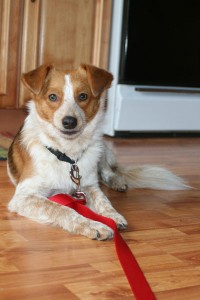
My newest foster.  A lil timid Sheltie mix.

My newest foster. A lil timid Sheltie mix.

It’s been about 2 weeks since Jagger was adopted. Risa and I let our lives go back to normal and it was nice having it just the two of us again. But there are always dogs in need and I knew I wanted to take in another foster. I just needed to wait and find one I thought would suit me well.

Last night, I picked up Sawyer right off the transport and brought him home. He is a pretty timid boy. He barely walked around the house when I brought him in; instead, he crawled like he was trying to remain very small. Sawyer was leery about me taking his collar on and off and he did not want to go into his kennel. Despite being a 6 month old puppy, he acted like a very scared dog.

Today, of course, he’s opened up a lot. He’s trotting around the place with his tail up high, play bowing, jumping on me, and barking. He’s certainly still a relatively fearful little one but he seems to get over it quickly. Unlike Jagger who arrived like a firecracker, Sawyer is much more reserved. He is starting to remind me that he’s a puppy today, though. That’s one thing I was not sure if I could handle. Building up confidence in a fearful dog I can do. Risa was a great teacher in that respect and I’ve vowed not to make the same mistakes with little Sawyer that I made with her. I’m just not sure I have the time to dedicate to a puppy. Fortunately, due to his age and extreme cuteness factor, he probably won’t be with me long. 🙂

I might be some sort of Sheltie mix.  Maybe with some Jack Russell or Italian greyhound.  Who knows!

I might be some sort of Sheltie mix. Maybe with some Jack Russell or Italian greyhound. Who knows!?

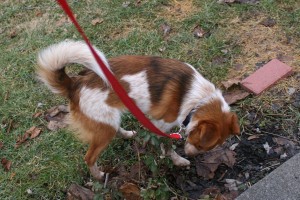
I’m not sure exactly what sort of mix he is. I am guessing, based on his size, that he might be a Sheltie mix. As to what else, I’m still undecided. I thought Jack Russell at first but now I’m leaning towards maybe Italian greyhound. Something makes me think Australian cattle dog could be in there too but I don’t really know. I suppose, as I get to know him better, some of his breed tendencies might show themselves and help me make better guesses. He is a cute little guy, though, that is for sure.

He’ll be a totally different challenge from preparing Jagger for a permanent home. I think I’m up for it. 🙂

Posted in Fear, Fostering | Leave a comment

Use It or Lose It

Without acknowledging and working on issues, they do not improve.

Without acknowledging and working on issues, they do not improve.

Risa’s Birthday was Thursday. She is now 9 years old (not that she’s even beginning to act her age). I usually buy her something nice for her special day and this year was no exception. Though I didn’t buy her a toy, collar, harness or anything else physical. I signed us up for a rally class instead.

It’s been close to 2 years since Risa has been enrolled in a training class. It almost pains me to say that. Partially because I know how much she enjoys classes and partially because not taking classes is killing us in the ring. I could see that, each time we stepped through the gates to compete, her focus was getting worse and worse. I knew we needed to get into more situations where I could work her around heavy distractions. It’s just that things weren’t working out as far as getting us into a class. There aren’t a lot of options for various reasons. She doesn’t need a basics class (and many of the dogs in those classes are not well-controlled which is a problem for us) and some of the trainers require vaccinations I would prefer not to give (like kennel cough). So we had to wait until we could find a class that fit us.

I signed us up for the Advanced/Excellent rally class again. We took this class before but the AKC has added new signs since. Besides, the issue for us isn’t learning the signs. I know them and Risa is pretty good at 98% of them. She needs the class to learn to focus on me among distractions again. Otherwise, we’re doomed to repeat last weekend!

I wish we’d been able to sign up sooner. Had I attended our first night of class weeks before the trial, I never would have entered her in competition. The last time we took a class there, Risa was great. Her focus was amazing and I could stand around with her without having to watch everywhere like a hawk. I could take her through a course off-leash without worry. Dogs could get within 2-3 feet of her without her doing more than looking into my eyes and waiting for her click/treat. It amazed me how much had changed.

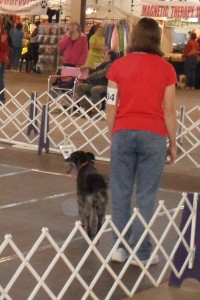
She wasn’t bad considering. But dogs could not get close to her without her lunging at them. It was very difficult for me to find a good place to stand with her and I felt like I needed to constantly manage her space and move us around a lot. As much as I wanted to get her in the ring to run the course we had set up, I couldn’t get her close enough to the entrance to make that clear. We had to stay back; there were up to 6 dogs milling around that area. With as touchy as she was being, there was no way I could stand near the ring entrance. It’s been so long since she’s been in such close proximity to many dogs she doesn’t know that she had forgotten what to do. I could see her start to remember as the night wore on and there were a few dogs she was downright curious about. She even snarked at a couple and, once they turned away, stretched out to investigate them. 😉

Once we got into the ring, her focus was gone. Honestly, had she behaved like that during the fun match 2 weeks ago, I would have been better prepared for the disaster we faced during the trial. My dog, who the instructor remembered as being very good at rally, looked like she’d never really done it before. She was so out of practice.

I remember, as a young child, being told that “If you don’t use it, you lose it.” It’s a bit clich

Posted in AKC, Dog Sports, Fear, Rally, Reactivity, Thoughts, Training | Tagged | Leave a comment