A Matter of Trust

New sights. New smells. New sounds. New people. New dogs. Same old fears.

She put on the breaks and outright refused to move any closer to the poop disposal can. No amount of coaxing or leash pressure would uproot her from that spot.

Every time we pass a person in the hallway, she bolts to the end of her leash trying to escape.

At the vet’s office, she climbs into my lap and shakes uncontrollably.

When a storm comes through, she paces the house non-stop with her eyes wide and unfocused. She pants heavily the entire time.

She lashes out at other dogs who get too close. It’s starting to get to the point where she’s barking and lunging when a dog is 10+ feet away.

It’s like I don’t even exist when we’re outside together. I’m just the anchor on the other end of the leash keeping her from going wherever she wants.

I knew from the get go that Risa was a shy, fearful dog. The shelter was honest with me about her issues. Back then, I thought I knew a lot about training dogs and figured I would have no trouble rehabilitating this scaredy mutt. I knew it would take some work and some time before she was a confident dog. I had faith in myself that I could do it. Unfortunately, I soon found out I was in way over my head, that I didn’t know half as much as I thought I did, and that Risa and I had a long road ahead of us.

My first thought after bringing Risa into my life was that I needed to socialize her. It was clear she had limited life experiences, little interaction with people, and a strong fear of new places. So, a week after I brought her home, I took her to Petsmart on a busy Saturday. My heart was in the right place. I wanted to show her that there was no reason to worry. I failed to realize that this dog had not had the time to build a relationship with me. She barely knew me. And I dropped her into the middle of one of her nightmares. It was too much activity. Too much new. She faced it all on her own and she was terrified.

It didn’t get much better after that. Due to my ignorance, I set us both up for failure time and time again. I let dogs rush up to her and greet her because I didn’t know what else to do. I permitted strangers to try and pet her even when she ran away from their hands. I continued to get frustrated with her when she bolted away from things that frightened her. There were numerous nights that I came home from somewhere with Risa and I broke down crying. I was at a loss. Everything I tried failed. I wanted her to be more confident and I wanted it now. I dreamed of ‘six months from now’ when I knew I could look back and see improvement. What I failed to realize at the time was that there is one thing you need to have to successfully rehabilitate a fearful dog: that dog’s trust.

Did you hear that?!

Trust is a tricky thing. You cannot teach trust. You cannot force a dog (or a person, for that matter) to trust you. Trust cannot be proven by words, especially to a non-verbal species. Trust must be demonstrated and proven. Trust must be earned.

So how does one go about earning a dog’s trust, especially when they’ve already proven to that dog that they cannot be relied upon?

One of the most important things is learning to listen. Dogs are communicating with us all the time through their body postures and positions. Once we understand their language, it’s so much more obvious what they’re feeling. We all want to be heard and our dogs are no different. When you listen to your dog and remove them from situations they deem scary, they learn to trust you. You have proven that you are listening to them and taking their opinions into consideration. To those of us who are used to more traditional methods, this seems insane. The dog should listen to us no matter what, right? But a fearful dog benefits from a handler who maintains open communication and takes their thoughts and feelings into consideration.

If you’re currently struggling with a fearful dog, you should brush up on your dog language skills. Books like On Talking Terms with Dogs: Calming Signals by Turid Rugaas, Canine Body Language: A Photographic Guide by Brenda Aloff, or Canine Behavior: A Photo Illustrated Handbook by Barbara Handelman would be great additions to your library.

Besides listening to your dog and learning what his/her thresholds for scary situations are, you should try and change how your dog feels about frightening encounters. For most dogs, this involves giving them super awesome treats when they’re faced with something scary. This is known as classical conditioning. If done correctly, your dog begins to associate something that formerly caused them fear with the promise of something great!

I have used and continue to use classical conditioning in working on Risa’s dog reactivity. When she sees another dog, I give her a yummy treat until that dog is out of sight. Seeing a dog becomes a predictor for something good instead of a reason to be afraid.

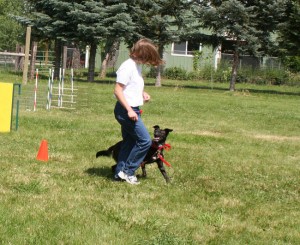
A busy location and dogs close by. . .yet Risa trusts me to keep her safe.

Of course, life happens while we’re training. I understand there are times when you cannot listen to your dog and remove them from a scary situation. Sometimes a dog will get too close and your dog will react. What you want to do is build up, over time, more pleasant experiences together. So, despite the occasional times when things go badly, your dog will still trust you to keep her safe.

I also like to encourage Risa to investigate and check things out. Curiosity is the opposite of fear. Should we come across something that startles Risa, I will stop and let her approach it. Initially, I had to do more coaxing and offer treats close to the scary object to get Risa to sniff it. I never pulled on her leash to get her closer to it; I always let her choose how close she wanted to get and how quickly she wanted to get there. If she seemed overly fearful, I would often crouch down next to it and coax her closer. These days, she loves to go over and sniff something novel in her environment. There are some things that still frighten her but she’s much more likely to check it out rather than just run away or keep her distance. She seems rather pleased with herself after finding out this new object was no big deal!

It is not an easy thing living with a fearful dog. Progress takes time. A lot of time. Though I dreamed of ‘six months from now’ when I first brought Risa home, we still had a lot more work to do even once we had reached that milestone. I have spent 4.5 years working with Risa to increase her confidence and help her be less fearful. Most of the time, she appears to be a normal dog and I’m very proud of that. However, she is still a fearful dog. It’s very possible she will always be afraid. I have accepted that and all the limitations associated with it. She’s never going to be the confident dog I originally wanted. But that doesn’t make her any less of a dog nor does it stop us from enjoying time together and competing in dog sports. 🙂

If you’re still struggling with your scaredy dog, I think the books Help for your Fearful Dog by Nicole Wilde and The Cautious Canine by Patricia McConnell are indispensable. The website Fearful Dogs is also an excellent reference.
Posted in Fear, Reactivity, Training | 1 Comment

Just A Mutt

What type of dog is she?

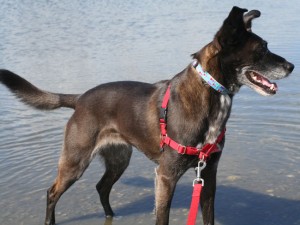
That’s what I usually reply when asked “What kind of dog is she?” It seems most people are disappointed by my answer. Risa is a very unique-looking (aka weird-looking) dog. I suppose everyone expects her to be some rare breed or some new designer dog. Alas, no. She is simply a mutt.

Perhaps it’s my word choice too. I always call her a mutt. To most people, this is a derogatory term. But it matters not to me. Mixed breed, mongrel, All American Dog. . . Whatever you want to call her doesn’t change what she is. She is a dog without a purebred pedigree. A mix of this and who knows what.

I have, at times, toyed with the idea of making up a fancy name for her along the lines of goldendoodle or puggle. There’s only one major problem with that: I don’t know what type of mix she is. If I knew, I would probably answer “border collie cross” instead of “mutt!”

Border collie + greyhound = Risa? I think there's more to it than that.

At one point, I decided to call her a “Western Montana Herding Dog.” I’ve always suspected she has some herding breed(s) in her and she was born in the western part of Big Sky Country. However, I had to stop calling her that after I took her herding. She had no herding instinct at all and preferred chasing sheep rather than trying to gather them up and move them somewhere.

I suppose I could answer “lurcher” as I’m fairly certain she fits that description. A lurcher isn’t a breed of dog, but a type of dog. It’s a cross between a sighthound and another breed of dog (historically it was a herding breed or a terrier). However, that requires more explanation than “mutt” and still doesn’t give any definitive answers. I have no idea which sighthound or other breed(s) are in her background.

It is certainly human curiosity to want to know. I do not blame people for asking. I wish I knew what she was! Honestly, I would love to give a straight answer and one more descriptive. But I cannot. I will never know for certain what breeds are behind my dog. People can continue to guess what she is. I like when they play the guessing game with her mix. I have heard some combinations that sound plausible and others that are out there in left field. Her uniqueness is something I treasure.

At the end of the day, it doesn’t matter what she is. It’s clear to me that she’s certainly more than “Just a mutt.” She’s my friend and my close family. My exercise partner. My social life (I meet the best people through my dog!). Risa has helped me be a better person and has taught me many things. She’s a one-in-a-million dog. And she’s all mine. 🙂

Posted in Uncategorized | 2 Comments

General Thoughts and Resources about Reactivity

I know there are a lot of reactive dogs out there and people have varying ways of dealing with their dog’s reactions. For sure, owning a reactive dog is a challenge. It’s embarrassing. You feel like you should be doing something but you’re not always sure what to do. Sometimes you just want to hang up your dog’s collar and never leave the house with them again!!

When used properly, the prong collar can be a valuable tool. However, I feel it has no place in rehabilitating a reactive dog.

Many people start with collar corrections to try and curb their dog’s reactivity. I know that’s where I started. It seems like the right thing to do. You don’t like what your dog is doing so you make sure to let them know by issuing a correction. In time, your dog will stop reacting. But is that what really happens?

In my experience and from what I’ve read, this is rarely the case. One of two things can happen. You can actually make the behavior worse by pairing corrections with the sight of another dog. Or you eliminate the behavior but not the underlying cause.

When your dog reactive dog sees another dog, he gets tense. When the stress becomes too much, he explodes in a lunging fury trying to drive the other dog away. Then, out of nowhere, he gets a collar correction when that dog gets near. Over time, he may connect that correction to the appearance of another dog. His reactions may start sooner and be more intense. “Go away! If you get close, I’m going to get corrected!” Suzanne Clothier discusses this in one of the great articles on her site: Flying Dog Press.

On the other hand, you might be successful in stopping your dog from barking/lunging like a maniac when he sees other dogs using collar corrections. But punishment only suppresses behavior. He is still afraid and tense. What might he do now instead of barking and lunging? Squeal? Pull away? Turn and grab your pant leg? Something worse?

I know of others who don’t correct a dog for reacting, but for ignoring a cue before their reaction. These owners tell their dogs to ‘watch them’ or ‘sit’ before a dog approaches. If the dog fails to comply, they are issued a correction. While we as humans are capable of making that distinction, I’m not sure dogs always are. Not to mention I think it is very difficult to look away from something you find terrifying!

A flat collar (left), a front-clip harness like the Easy Walk (middle top) or the Sens-ible (middle bottom), or a martingale collar (right) are all better alternatives.

I think it helps sometimes to think of what your dog is going through in human terms. For my examples, I’m going to use arachnophobia (the fear of spiders) since it seems to be a common human fear.

Imagine you’re terrified of spiders. You see one in the room and you scream and run off in fear. As soon as you react, someone yells “NO!”. Every time a spider shows up and you cry out, you get screamed at. What are you going to do? The sight of a spider is now worse than ever. Not only is it frightening to you, but someone chastises you whenever you do anything about it! Maybe you could stop screaming and running to avoid being shouted at but what else can you do to alleviate the stress of seeing one? Perhaps you’re tired of being yelled at and decide to hit them?

How about instead of being yelled at for freaking out, the same person tells you to look at them whenever the spider enters the room. You know the spider is there. But they insist you maintain eye contact with them. How close is the spider now? Is it getting ready to climb on your arm or still 10 feet away? You turn to look for the spider and you get shouted at. You’re told to keep looking at them, not the spider. You must have a LOT of trust in a person to assume they will keep you safe from the spider and be able to ignore the scary thing in the room.

On our final trial, the spider enters the room and you run away shrieking. Someone hands you $100. Again, a spider shows up and you get $100. Every time a spider arrives someone hands you $100. You start to feel differently about that spider now, don’t you? While he used to cause irrational fear, he is now a predictor of something spectacular. You start to look forward to seeing the spider knowing that $100 is on the way!

That final example is what’s known as classical conditioning. Pairing something great with something bad (or it can be neutral). The sight of the stimulus = the presentation of something awesome. No matter what the subject is doing at the time. I know it seems counterintuitive, like you’re rewarding your dog for it’s bad behavior. However you cannot reinforce emotion (like fear). Not to mention when a dog (or human!) is reacting, they are incapable of thinking. It’s impossible for them to think “My person is rewarding me for losing my mind!”

With a lot of hard work and patience, your reactive dog can learn to enjoy the company of its own kind.

If you find yourself struggling with your dog’s reactivity, your best bet is to find a qualified trainer who uses confidence-building, positive methods to rehabilitate your dog. Working with a reactive dog is a long, hard road. You’re more likely to succeed if you have a hand to hold along the way as well as a support group when you have set backs. I was never able to enroll Risa in a reactive rover or scaredy dog class. Most of her training I have done on my own with just a network of online friends who understood what we were going through as my support.

If you have no luck locating a quality training class, I would highly recommend grabbing some books and finding a spot on the couch to enjoy them. The books I found the most beneficial are:

Scaredy Dog by Ali Brown: This book was the turning point for me and Risa. My “Ah ha!” moment when I finally realized Risa was behaving ‘badly’ because she was afraid. I cannot recommend this book enough. The DVD is a great companion (ha, pun!) to the book and is especially helpful to those who prefer to be shown what to do.
Focus, Not Fear also by Ali Brown: Her second book follows a class of reactive dogs. Inside, you can experience how she runs a reactive class as well as ride the ups and downs of the rollercoaster that is reactive dog rehabilitation.
Fiesty Fido by Patricia McConnell: I love Patricia McConnell’s stuff and this short book is no exception. It’s a quick read and full of good information and exercises to try with your reactive dog.
Click to Calm by Emma Parsons: This book also contains great step-by-step instructions on how to rehabilitate a reactive dog as well as first hand experiences from the author.
Fight! by Jean Donaldson: Don’t let the title scare you away, this book addresses dog reactivity, poor self control (which often manifests itself in a similar fashion), as well as true dog aggression. It’s another quick read but full of great information.
Help for your Fearful Dog by Nicole Wilde: While this book addresses all aspects of canine fears and how to help your friend overcome it, it does spend some time on reactivity. Since reactivity is fear-based, you’ll find a plethora of pertinent information in this book.
Control Unleashed by Leslie McDevitt: While not a reactivity-specific book, this book contains many exercises that can benefit reactive dogs. The “Look at That” protocol is especially helpful.

On top of books that focus on rehabilitating reactive dogs, any book addressing canine body language/behavior is a must! You can avoid a lot of trouble by learning to read your dog. I would recommend On Talking Terms with Dogs: Calming Signals by Turid Rugaas and Canine Behavior: A Photo Illustrated Handbook by Barbara Handelman. Friends of mine also have good things to say about Canine Body Language: A Photographic Guide by Brenda Aloff though I have never read it.

Posted in Books, Classical Conditioning, Fear, Reactivity, Training | 2 Comments

Blog the Change: Heroes Refuge

Imagine you’ve chosen to serve our country. The call comes in. You’re being sent off to a foreign land to fight for our freedoms. Who is going to watch Rex and Bandit while you’re gone? Do you have a willing friend to take care of them while you serve? Or will they be dropped off at the local shelter in the hopes that they can find a new home while you’re gone?

Now envision you have served your country (or city). You were a K-9 cop or military working dog your whole life. Now that you’re retired, where do you go? Is there a family out there willing to adopt you? Are you really suited for civilian life? What alternative do you have if you’re not?

In steps Heroes Refuge, an upcoming organization designed to help both enlisted servicemen and women as well as retired working canines. Heroes Refuge’s will be “A place where your pet can have a home while you protect ours.” It will also be a place where retired K-9s or military working dogs (MWDs) can live out the rest of their lives in comfort.

Heroes Refuge is still in its infancy and no location has been chosen yet. It is the brainchild of a close friend of mine and I have helped as best I could along the way. At the very least, I designed the logo. 😉 I feel this project has so much potential and thought today would be a great day to help spread the word about it.

You can learn more about Heroes Refuge on their website and on Facebook.

Blog the Change

Posted in Causes, Uncategorized | 6 Comments

Why Don’t We Just Dance?

“The great pleasure of a dog is that you may make a fool of yourself with him and not only will he not scold you, but he will make a fool of himself too.” –Samuel Butler

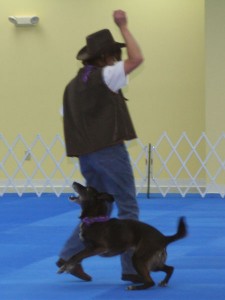
Risa performs backward circles around me at a freestyle competition.

Dancing with your dog. Just saying it out loud it sounds foolish. You can picture it now. Fido’s paws held in someone’s hands as they circle around the room to some ballroom ballad. You roll your eyes at the very thought.

But there are people out there competing in a canine sport that involves dancing with your dog! It is a bit silly, sure. However, it’s far more fun than you may think! Think of it more like obedience behaviors performed to music.

Risa and I have been involved in canine musical freestyle for quite a while (almost 4 years now!). After we finished our 2nd obedience class, our trainer mentioned offering a class in musical freestyle. At the time, I really wanted to do agility and thought dancing with dogs was stupid. I was open-minded, however, and wanted to get Risa into something that was more involved than just general obedience. I knew it would help us bond better so, despite my reservations about the activity, I signed us up.

It turned out Risa was a natural showman. Who would have thought this shy, fearful mutt would enjoy putting on a show for an audience? Her natural athleticism, happy grin, and helicopter tail lends itself perfectly to this flashy sport. I couldn’t help but be sold on canine musical freestyle. Risa absolutely adores it and I do too.

Having participated in a few demos, taken classes, practiced with fellow freestylers, and competed; I’ve really come to enjoy what freestyle has to offer. Firstly, it’s unique. There is no set routine for a freestyle performance. You pick the music. You design the dance. Each performance is uniquely your own. As an artist, this freedom of creativity really draws me to freestyle.

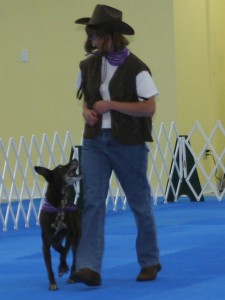
Happy heelwork at our second freestyle demonstration.

Another thing I like is the variety of behaviors you can teach and utilize in a performance. About the only behavior you NEED to have is heeling (preferably on both sides). Beyond that, the sky’s the limit! You can do weaves, jumps, spins, bows, circles, high fives, etc. This freedom also makes it easier for dogs who, for whatever reason, cannot perform certain moves (like dogs with joint problems who cannot attempt jumps). While each venue of canine freestyle has differing requirements for performance, most of them are pretty open about what movements you must do.

There are three different organizations who offer competitions for canine musical freestyle: World Canine Freestyle Organization (WCFO), Musical Dog Sport Association (MDSA), and Canine Freestyle Federation (CFF). Each has its own unique requirements as well as benefits and disadvantages. I feel it’s up to each competitor to figure out what they want to get out of canine musical freestyle and determine which venue is best suited to them and their canine partner.

For example, Risa and I compete in WCFO freestyle. What I like about WCFO is that there are several options for you as a competitor. You can compete in “Heelwork to Music” divisions where the focus is more about your dog maintaining correct heel position during the entire routine. There is also the “Musical Freestyle” divisions where the only requirement is that you don’t do anything dangerous; it’s pretty much anything goes! You can also compete in the ring with two dogs and one handler (Brace) or even as a group! On top of offering live competitions, you can also compete via video. This is a great option for teams who don’t live close to trials or individuals who own dogs that aren’t candidates for live competitions.

The look on her face says it all. Risa loves to dance!

About the only thing I do not like about WCFO freestyle is the costuming. (To my knowledge, CFF freestyle is the only one of the three that does not require the handler to dress up in costume.) When I first started doing freestyle, I was so against costumes at all. I already felt silly enough. So, for the first few demos and our Beginner title in WCFO freestyle, my costume was very simple. I wore jeans, brown shoes, a white T-shirt, and a red bandanna. Fortunately, we danced to country western songs so this get up was appropriate. 😉 As time as gone on, I’ve gotten a bit more comfortable with the idea of costumes though I prefer to keep it pretty basic. My costume for our current routine is not much different than the one that came before it. The only additions are a belt, a vest with fringe, and a cowboy hat.

No matter which venue you compete in, costuming on the dog is supposed to be limited. Most venues permit some sort of collar or bandanna on the dog’s neck. Some allow wristbands around the dog’s legs. Nothing that impedes the dog’s movement should be utilized. In both of our routines, Risa has worn a simple bandanna. Red for the first. Purple for the second.

I think Risa will forever be a freestyle dog. No matter what other venues we have tried and will try, freestyle seems to be her true love. Though I originally envisioned us racing around a course of obstacles, I too have fallen in love with the joys of canine musical freestyle.

Posted in Training | Tagged | Leave a comment